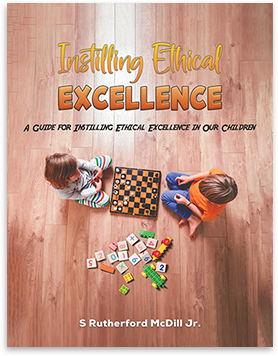
We teach our children about right and wrong by how we act
A funny thing happened on my way to my doctoral degree. I wanted to do some research on the idea of Human Excellence before books in the very early eighties came out about excellence in the fields of industrial, organizational, and managerial leadership. In my literature review (dissertation Chapter Two) I had to read extensively in the domains of philosophy, psychology, and religion. I thought I’d be hit with crazy inconsistencies of opinion on what constitutes human excellence and have a crazy hard time making sense of it all. Instead, I found a surprising and striking convergence of ideas about excellence regardless of the antiquity of the literature, its culture, its region, or its religion. The literature worldwide seemed to unite on the basics of excellence of character. The central themes? Peacefulness, gentleness, care. A feeling of oneness with mankind, and comfort in and with the universe. Persevering patiently and calmly through hardship, acceptance of one’s circumstances. Kindness, humility, bearing and sharing of others’ burdens. Sharing of goods and of self. A keen refinement and sense of the moral. Absence of envy and jealousy, of hate and greed. The literature tells us that such people live with a sense of creativity, autonomy, objectivity, a concern about mankind. They can accept themselves and others. They keenly distinguish between right and wrong, and set their bearings on what’s right. They have heightened sensitivity to the needs of others. They are spontaneous. They lift themselves above their own needs and see and tend to the needs of others. They strive to fulfill their potential, but not at the expense of another. They are grounded in and guided by their higher-order moral values. Their ethical lives are above reproach. They are stable and reliable. They are friends, loving brothers, and sisters to all humanity. What I found was the recognition of a sense and belief that there is something far more important than oneself, something more to being human than mere immediate me-centered experience. It involves exploring certain universal others-centered themes - love, compassion, morality, altruism, wisdom, and truth. Let’s remember that the kind of world we live in affects who we become. Conversely, the kind of people we are affects the kind of world we live in. The dark hostile world of Thomas Hobbes in which he said people live lives that are “solitary, poor, nasty, brutish, and short,” is not the kind of world we want to build for ourselves or our kids to inhabit. We want to build and bequeath to them a moral/ethical world in which people trust and care for one another. And one in which they are equally trusted and cared for. That kind of world doesn’t happen on its own. It must be built as described in my prior Guide.
Post Views : 57